Monday, March 28, 2011

(In)effective communication of (non)science to the public (part 2)

     In part one, I stuck to describing some (far from all) of the silliness that is present at the Creation Museum. It's one thing to assert that dinosaurs were all vegetarians, penguins roamed the jungles, and plants are not alive, but what really bothers me is some of the ethical claims made.

Gasp!

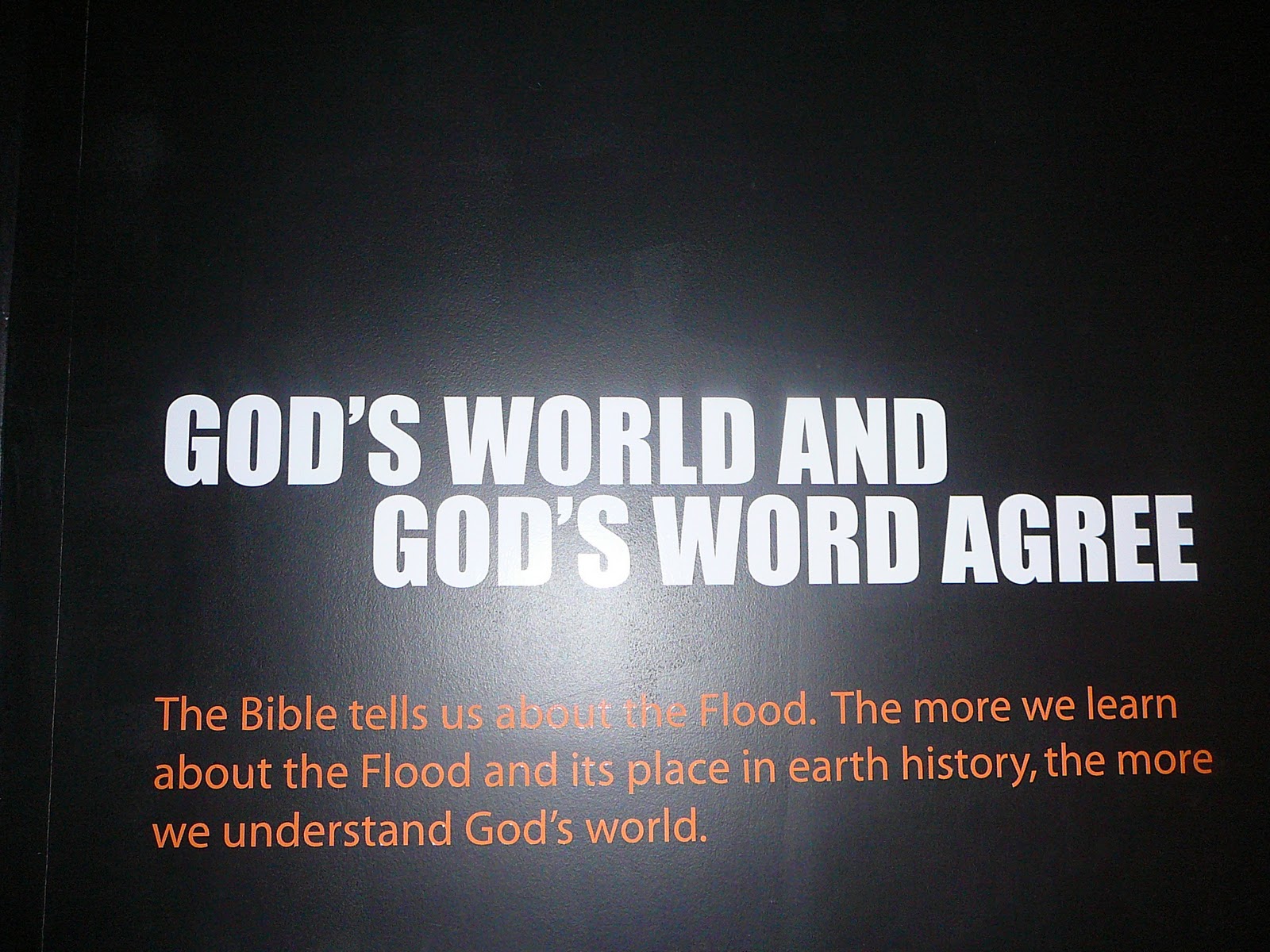
     According to Answers in Genesis, the group responsible for the Creation Museum, all ethics and morality come directly from the bible and nowhere else. This is the issue in the first sentence, as god's word (the bible) is considered an “absolute authority for right and wrong”. Humans have used many excuses to justify “abuse”. While this is certainly true, it seems that the absolute authority of the bible and other religious texts have been used to justify abuse as well. Sectarian violence in the middle east, the crusades, and the Spanish inquisition spring to mind. Christopher Hitchens has written a book that describes how god's word has been used to justify abuse throughout history. The bottom line is that drawing morality from the bible does not make people inherently more moral than those who draw it from elsewhere, and may in fact make them less moral.

     There's something terrifying about ABSOLUTE AUTHORITY. I think flexibility is important, though I'm sure  Hammurabi would disagree. More importantly, I am deeply offended when I hear people claim that anyone who doesn't draw their morality from the bible is an amoral person. I live my life according to what I think are just principles. I don't steal anything, and I certainly don't murder anyone. I do these things without having to read a book to know they are wrong. It's self evident that they are wrong. Consider this statement: It is unjust for the innocent to suffer. If you understand the meaning of the words “unjust”, “innocent”, and “suffer”, then the truth of the statement is apparent.

     The rest of the paragraph jumps all over the place. There's something about modern humans, who apparently are similar to ancient humans. Then we have a claim about the abuse of science, but without any examples to support that claim. Finally, there are claims made by evolution (?) about why humans are nothing special. What these three thoughts have to do with each other, I can't grasp, but let's look at what evolution has to say about humans.

     There are many people who reconcile the fact of evolution with the belief in a supernatural creator of some sort, believing that the creator  created and then evolution did it's thing. I don't buy into that because I see no reason to complicate the world with supernatural excuses for human ignorance. The magical, indescribable, and fundamentally unknowable actions of a supernatural being simply cannot be used to explain anything. They can be used as excuses for a lack of explanation, or a convenient place-holder until we figure things out, but their power to explain is nil. What's more, who's to say that humans are not accountable to anyone? I'm accountable to my students, advisor, professors, peers, family, friends, and myself. I don't get to act without consequences, and people depend on me for things. What an outrageous claim!

     Next we have a claim about the branching of the family Hominidae, which includes orangutans, gorillas, chimpanzees, and humans. This claim is supported by a mountain of repeatedly and independently confirmed empirical data, and countered by a book. How the truth of our evolution makes us nothing special evades me. We're the only species to invent the internet! We're the only species to do a lot of things, which seems pretty special to me.

     I'm not even sure what to say about this next one. Is death a  supernatural step in the cycle of life? It certainly seems to happen 100% of the time. Or maybe death is a natural step, but life is not a cycle, per se. I'm not sure what this would mean, but either way, it doesn't seem to have any bearing on whether or not humans are special in any way.

     Finally, we've got a serious taxonomic problem. The bible draws crazy distinctions between animals, plants, and humans. If humans aren't animals, what are we? Plants? Protists? Fungi? Bacteria? Something else? Biblical literalists also must grapple with the fact that humans and all other animals share a staggering amount of DNA, physiology, and anatomical features. Explanations for this are nothing more that ad hoc goalpost shifting, a practice that ultimately does nothing but pile one excuse on top of another. The claim that “only the fittest survive” misrepresents the scientific definition of fitness, and again fails to say anything about whether or not humans are special in any way. All of this is such a confused mess, it's quite comforting to see that scientists aren't the only ones having trouble communicating with the public.

     But all of my arguments are useless when held up against fanatical devotion to circular logic.

Behold the TRUTH! It is TRUE because it is TRUE!

     Why is it that religious leaders can say these four words and be done with it while scientists must toil endlessly to convince people that the climate is changing faster than expected, or vaccines don't cause autism, or that species change over time? Does it make sense to believe outrageous, extraordinary claims without evidence but then to reject decades of evidence in support of a comparatively mundane claim? What is the thought process going on here? There is much cake being had and eaten, which is supposedly impossible. In a world like this, how can scientists effectively communicate anything? We're immediately discredited, and while we try to communicate, Joe T. Public has the bible stuffed in his ears. Or a bunch of tiny bibles, I don't know. Perhaps time travel will be invented, allowing someone to go back and edit the first bible to say “P.S. Scientists are cool, trust them”...

     Why does the public express skepticism about claims made by scientists but not by religious leaders? Scientists actually have more books than religious leaders to support their claims, so it must not be related to the amount of evidence supporting a claim. The quality of the evidence might be the issue, but that brings us back to the first point. “God's word is true” is apparently of the highest quality, whereas all of the published results scientists have discovered aren't up to snuff. Is it even worth trying to communicate with these people?

     This all must have something to do with the values held by people. Why does the public try to investigate the personal motivations of scientists when they make claims, but fail to bring this same level of attention to their religious leaders? Is it because all scientists are immoral heathens out to corrupt the world with their knowledge? By comparison, anyone who believes a statement without evidence must be a good person. I know that I'm making a caricature of this whole mess, but my point remains: the public is selective in their willingness to believe claims, regardless of the evidence presented for or against those claims. It seems that the only way forward is to get the public to change their values, which has started to happen somewhat with the green movement. Caring for the planet by reducing consumption and pollution seems easily reconcilable with biblical values, but what is the stem cell researcher to do? When coming up against ABSOLUTE AUTHORITY, does it even make sense to try communicating with the public?
They sure do!

Monday, March 21, 2011

(In)effective communication of (non)science to the public (part 1)


       I recently traveled to a magical land, forgotten by time and reason. Dinosaurs roamed about and nothing ever died. Sound familiar? Well, if you've ever read the bible and taken it literally, this is how the world used to be. This view of reality is preserved at the CreationMuseum, located in Kentucky just a short drive south of Cincinnati. Their slogan: Prepare to believe. I really wasn't sure how to go about preparing, but I did bring my camera.

       The museum is run by a group called Answers in Genesis, a fairly extreme Christian group of young-Earth creationists. They are pretty nutty. Being a zoology graduate student with a fairly strong grasp on evolutionary principles, I made this trip largely for laughs and to see how the other side lives. It was also of interest considering the seminar I'm taking (Effective communication of science to the public) is the reason for this blog began.

       The Creation Museum (though arguably not really a museum) is big on dinosaurs. Really big. Every advertisement I've ever seen for the place features dinosaurs, and dinosaurs are the first thing we encounter upon entering. After the dinosaurs comes the ticket booth (an outrageous $25!), but then we're back to more dinosaurs. They then take your picture with dinosaurs ($20 if you want a copy!), and then you move along to see more dinosaurs.

 Dinosaurs and people together, wow!

       We're taken to a scene of a paleontological dig site, where two researchers work side by side on the same fossil. One is a creationist, the other is an actual scientist. This is some text that appeared near the exhibit:


       The first part is fine, and certainly true. The second part is also true, as scientists can look at the same set of data and come to different conclusions. The problem arises when one “scientist” interprets facts according to a book written a few thousand years ago and the other scientist interprets facts according to the current understanding of professionals in the field, which relies on peer-reviewed published records documenting empirical findings. The conclusions reached by these two researchers couldn't be more different. The creationist claims (from the authority of a book) that the world was created a few thousand years ago and all the fossils are a result of a global flood. The real scientist claims (from the authority of countless lines of empirical evidence that has been repeatedly tested and confirmed by other independent scientists) that the world was created billions of years ago and that fossils are a product of slow processes that continue to act today. Which of these claims makes more sense: believing you are right because a book says so, or believing you are right because your assumptions have been verified repeatedly for decades? I just don't get it.

     But who cares? Everything was just perfect in the world of the bible.

Look, a forest penguin!

     A literal interpretation of the bible creates some problems:


       Dinosaurs, cats, snakes, and hawks were all vegetarians. Neat! One must wonder why their teeth and digestive systems are so capable of seizing, ripping, and disintegrating protein from other animals. Or maybe one must not wonder about that. Don't wonder about that. Just accept the fact that despite the incredibly sharp and serrated teeth present in the jaw of the T-rex, it was content to eat peaches and dandelions. At least, that's what the bible says.

Delicious foliage!

       Wait a second! They were all eating plants, so why do the plants have to die but not the animals? The answer is simple: plants aren't alive!

Whew! That's good to know. I'll be sure to tell some botanists about this.

       But, you might protest, why do these organisms eat meat now? The answer, according to the book, is that after the fall of man everything changed:

Put those teeth to use!

       Some other things that could be hard to explain are easily handled when repetition from a book takes the place of critical thinking:

Revealed information? Sounds exciting!

Don't weed your garden, they're there to keep things in balance!

       Another big problem the bible has to deal with is why dinosaurs and other creatures no longer roam the Earth. The ark (a big boat) features prominently in the Creation Museum, and supposedly held two of each kind of animal.

Dinosaurs were on the ark, but I guess they all fell off to become fossils...

Assuming this model is correct, there may have actually been only one zebra on the ark!

     People who didn't get their tickets for the ark were left behind to work things out for themselves:

I don't see how choking someone will improve the situation.

     This is all pretty absurd, and I could go on and on about the ridiculous things I saw at the Creation Museum, but I'll stop here.

     Stay tuned for part 2, where I discuss what really bothers me about the Creation Museum and incorporate ideas about communication and the position of science in society.

P.S. To help myself sleep at night, I donated $50 to the National Center for ScienceEducation. This organization has played an integral part in defending science and reason from unsubstantiated pseudo-science masquerading as something that deserves attention in our classrooms. If you care about the quality of science education in this country, please give what you can to this group. They were largely responsible for the legal defeat of intelligent design in  Kitzmiller vs.Dover.

Wednesday, March 9, 2011

Story time

     There's an interesting discussion developing on ECOLOG, a listserv for ecologists, about the roll of hypotheses in ecology. At the base of this discussion is whether or not science needs to be hypothesis-driven. Certainly, statistical analyses are suited for hypothesis-driven science, but does that mean that other types of research are somehow less valuable? What about natural history studies? Documenting changes in community structure or detailing the life history of a species can be the first steps that lead to important, hypothesis-driven studies (i.e., the kinds of projects that will get funded).

     What does any of this have to do with children's stories? Most of these books deal with topics in basic science: biodiversity, life cycles, community interactions. None of these books are stories about hypothesis testing, and perhaps that is a good thing. For young children, we need to start introducing them to the biological sciences at the broadest, most easily understood levels. Perhaps if we can hook enough young minds, the larger issue of communicating science with the public will diminish...

Chickens Aren't The Only Ones
     The author's goal here is to share with children the fact that eggs exist beyond the ones chickens provide for our enjoyment. The science that's communicated here is basic organismal biology, and, as indicated by my blog title cum web address, it's a shame the author didn't use this opportunity to link organisms in an evolutionary context. Children are notorious for asking "why?", so it seemed fitting to put some kind of explanation into the book. Perhaps that was too much to ask...

Old Shell, New Shell
     The author takes a story about a hermit crab looking for a new shell and uses it to introduce an impressive array of organisms that most children will not be familiar with. The guide to all of the pictured species, with short blurbs about each, is impressive. I would have collected this information as a child and been proud to show off my identification skills at the drop of a hat. The introduction and concluding remarks regarding conservation are excellent additions for parents and their children. The sooner we can get children to care about the environment, the better.

Pumpkin Jack
     A disappointing tale of a jack-o-lantern left to germinate into a new pumpkin plant. I was truly excited for details about the decomposition process or even basic plant developmental biology, but alas, the story focuses more on what children do at different times of the year. The science here is superficial, though it is worth something to make sure children know where plants come from (i.e., other plants). I can't imagine a child ever wanting to read this book more than once, and I bet books need to be re-read ad nauseum to be remembered.

Round The Garden
     I was prepared to write a biting review of this story when I noticed it was written by an eight year old. Quite impressive, especially if he added the small flourishes like naming clouds and pointing out essential components of photosynthesis. Again, the science is fairly basic and doesn't explore much beyond the basics of the water cycle.

The Sea, The Storm, And The Mangrove Tangle
     This author includes what I think is an essential component of a good children's book intended to communicate science: an introduction. Whether written to be read to children or solely for the parents, this background is incredibly important because it allows questions to be asked & answered, and allows the readers to put the story in a realistic context. I read the story about the hungry caterpillar, but I never really connected it to lepidopteran ecology. This kind of science writing is the opportunity to take a cute story with pretty pictures and use it to actually educate a young person. Too often, this opportunity is wasted and perhaps not even comprehended by the author.

     Overall, the visuals were well done, especially when requiring a second look and concentration from the child. Detailed illustrations train children in skills of observation, which puts them well on their way to becoming scientists.

And remember, children are our future!

Monday, February 28, 2011

What we've got here is a failure to communicate


     Because this blog was created as a component of a seminar course on effective communication of science to the public, it stands to reason that I should be reflecting on this topic regularly. Now, defining "the public" is not always easy, and I've used Joe T. Public as my all-encompassing stand in, but it seems that I often consider myself to be one of the public. If the public are simply people who are not experts (or nowhere near experts) on a subject, then when it comes to new-fangled CMSB (cellular, molecular, and structural biology), I consider myself one of the public. Sure, I've had a few introductory biology courses that do a brief survey of these fields, but I've never had an advanced course, and I certainly don't read the literature. So, when I go to see a talk by a professional scientist doing this kind of research, I take on the role of the public with whom the speaker should be effectively communicating.

     At the last CMSB talk I attended, I think I understood three of the presenter's slides. There were probably fifty or so presented in total. Included in the three I think I understood are the intro slide (Hi, this is my name and where I work) and the closing slide (Thanks for listening, here's the people who helped me). That leaves one actual slide that I think I understood. Isn't this a major problem?

     I've already prefaced this with my admitted ignorance on the entire field of biology in which this presentation fit, but does that mean that the speaker should avoid making any effort to communicate effectively with me? This talk was not given at a special gathering of experts in the field, but rather to an entire department that is (unfortunately) labeled "zoology". We've grappled in seminar about the importance of casting your talk at the right level for your audience, so why is it that this talk (and CMSB talks in general) fail to do so?

     My two guesses: 1) scientists trained in this field are never taught [i]how[/i] to communicate effectively with the public, and 2) the science in this field cannot be effectively communicated to the public. I've left out the cynical third guess that assumes the scientists just don't care, but this may be the case. If the problem is that there is no training for communication in this field, one has to wonder why that is the case. Surely all science deserves to be communicated to the public. Most of the CMSB talks I've been to relate fairly directly to human health in some way, so it would seem that these scientists would have much to gain from communicating with the public. They'll never have a hostile crowd at their lab door, wielding pitchforks and torches, demanding justification for the work being done there. Perhaps it is this very issue that makes them such poor communicators: their work relates so directly to human health, they only have to state as much to satisfy Joe T. Public. When that level of communication is the extent to which you flex your communication muscles, it's no wonder you fail so spectacularly when someone wants to know more than the superficial about your research.

     The second guess is obviously an exaggeration, but I think there is some truth to it. In my areas of interest (behavior and ecology), most concepts are fairly intuitive. Of course females will be more choosy than males when selecting mates, they (typically) invest far more in their offspring than the males. Is anyone confused about this? Doesn't it make sense that prey would change the kind of food they eat when predators are around? They should eat food that gives them more bang for their buck, since wasting time eating less nutritious food exposes them to risk of predation. Simple, right? Finally, a topic that ecologists often describe as "complex" is the trophic cascade. But here it is, plain and simple: If you eliminate bears, you get more deer, and more deer means fewer plants. Do I need to repeat that?

     I think one of the main challenges a CMSB scientist faces is that the concepts in their field do not clearly apply to intuitive relationships that the public can see in their daily lives. We pay zero attention to transcription, cell signaling, gene regulation, and ATP synthesis even though these things are going on inside the cells that compose our bodies all the time. The inner workings of the cell are more abstract that the inner workings of an ecosystem, though both can be complex. However, I do not think all complexity is created equal. Compare these diagrams:


On the top is a food web; each sphere represents an organism, and lines between spheres represent the fact that things eat each other. On the bottom is a diagram of signaling pathways within a cell, linking all the different molecules that interact with one another. Sure, both of these diagrams have a lot going on and would probably intimidate Joe T. Public. The point is that one of these can be effectively explained to anyone in a few sentences, and the other one takes an advanced degree to approach intellectually.

Naturally, my viewpoint is biased, but I have yet to attend a CMSB talk that effectively communicated with me (the public).

P.S. There is a curious lack of CMSB students in this seminar...

Friday, February 18, 2011

Stresses of being a working mother


While I don't actually have any insight into the topic of this post (as related to humans), I'd like to share some findings from the world of spiders.

     Daiqin Li and Robert Jackson published a paper a few years ago investigating the role of predation cues on parental care in a spider. The focal species, Scytodes pallida, is a spitting spider that ejects a mixture of silk and venom from its fangs. Scytodes females carry their egg sacs around in their chelicerae (the parts attached to the fangs) until the spiderlings hatch.

A female Scytodes carrying her egg sac in her chelicerae

     This is clearly awesome, but Scytodes has a problem: it is preyed upon by another spider called Portia labiata. Portia belongs to the jumping spider family, known for excellent vision and surprisingly sophisticated cognitive abilities. Portia has learned (over evolutionary time) to preferentially consume Scytodes that are carrying eggs. The benefits are two-fold: 1) Portia gets to eat the Scytodes mother and her eggs, and 2) Portia is more successful at capturing Scytodes, since the eggs must be dropped before defensive spitting can commence.

A menacing Portia, the spider that eats other spiders

     The question Li and Jackson were interested in is whether Scytodes has any way to resolve the conflict between needing to carry eggs and defend itself from Portia. The authors predict that Scytodes may change traits related to egg hatching in order to solve this problem.

     Egg-carrying Scytodes were presented with volatile chemical cues (basically, smells) left behind by Portia. These cues could come from silk, feces, or anything else the spider leaves behind. The authors measured the time until the eggs hatched, how big the spiderlings were, and the proportion of eggs that failed to develop. They found that eggs hatched sooner and produced smaller offspring when Portia cues were present (compared to a control without any Portia cues). What's even cooler is that this effect of shorter incubation and smaller offspring was even stronger if the Portia providing the cues had recently eaten Scytodes. Although there was no statistically significant effect on the proportion of eggs that failed to develop, the trend was the same as incubation time.

Eggs from females under risk of predation hatched sooner

     What this all means is that Scytodes can sense predator cues and respond by speeding up the development of its offspring. The benefit is that the sooner the egg sac is gone, the sooner Scytodes can defend itself from Portia. A potential cost is that the offspring will be smaller than usual, which may put them at a disadvantage later in life. Presumably, this is better than getting eaten before the spiderlings even get to hatch. What a tough world these spiders live in! If only they could invent spider day care.

     Just how Scytodes changes the incubation time is not known, but this just demonstrates how science works. An observation leads to a question, and the answer to that question creates more questions. Scientists never stop questioning, and it seems like we may never run out of mysteries to solve. How's that for job security?

Friday, February 11, 2011

Obviously, this is our future...


Sampling some of the attempts to communicate a very complex science (climate change) to non-scientists (the ever-present Joe Public) reveals fundamental challenges in trying to make a point.


A Newsweek article takes the informed approach by stating that "global warming" is more than just a uniform increase in temperature across the globe. Furthermore, the author argues that extreme weather events cannot be blamed on climate change, since these events are products of local phenomena (e.g., air masses colliding). The real evidence comes from long term trends, though the wealth of data going back hundreds of thousands of years is curiously never mentioned.


I can't help but feel like the reader is walking into a bait-and-switch situation here: climate change is real and happening, but nothing we observe on a daily basis can be attributed to it. This seems like a great way to disconnect human behavior from larger processes, which is exactly the opposite of what we should be trying to accomplish. The author tangles with some real science-type words by writing about a high pressure system that has intensified an average of 0.9 geopotential meters every decade over the past 60 years”. Knowing that this kind of language would be lost on readers (why even use it?), the author translates into "layman terms". I wonder if this strategy is ineffective: layman is defined as someone lacking knowledge. What is the value in trying to communicate like this?


The conclusion of this article is especially terrible. Climate scientists at Duke are portrayed as having given u the search for a "natural" explanation for their data and then fallen back on the last remaining explanation of human-induced change. I sincerely doubt this is the method by which the scientists did their study. The author fails to end with any advice about what can be done, and instead seems to suggest that we should just strap in and enjoy the ride. Who knows what's coming next with all this wacky global weirding!?


Two articles from Time magazine, from 2006 and 2010, illustrate more issues in communicating this important message to Joseph T. Public. The first of these contradicts a main message from the Newsweek article by attributing a series of extreme weather events directly to global warming. Now Joe doesn't know what to think, because even the journalists can't decide how to interpret our world! While the analogy of earth as a living organism is childish and stupid, the author at least takes the time to highlight the nature of some of the changes going on: glacial melting, release of soil carbon, ocean conveyor belts, and drought. The author likely alienated a number of readers by overly politicizing the end of the article, in a section titled "What we can do" (which, incidentally, gives no advice about what we can do).


In 2006, it seemed that many skeptics had been convinced that climate change was real, but the story is very different in 2010. The author points out how scare tactics ("I have a nightmare" vs. "I have a dream"), may be responsible for the loss of public belief in climate change. This approach relates back (again) to the deficit model: Joe will not be convinced by all them crazy datas; scientists need to appeal to his values. There's some oddness in here about people who believe the world is a just place, but I'm not sure how that fits with the story being told here. Is there any hope in communicating a message to someone who believes the world is a just place? If it is, then why do anything? Justice will sort it out, right?


The author concludes that the public can't be won over by scare tactics, though active mis-information (i.e., lies) are incredibly effective. The solution for scientists is thus made entirely clear: stop scaring people with reality, and start lying to them about a fantasy land of musical rainbows and chocolate snowflakes. Hooray!


Thursday, February 3, 2011

On becoming a more best writer


     Here I comment on two selections from a book called The Best Science Writing of 2010, both focused on the consequences of what we eat. Before I delve into each article, consider the initial approach of both. In All You Can Eat, Jim Carrier begins with, “The green dumpster behind Red Lobster was nearly empty when I lifted the lid”. In Graze Anatomy, Richard Manning begins, “Will Winter and Todd Churchill have a plan”. Unless you are borderline comatose, how do you put these articles down after reading the first sentence? What is this guy doing in the dumpster, and what are those two planning? Now consider the first sentence from one of the peer-reviewed scientific publications currently sitting on my desk. In an article titled “Interactions of multiple predators with different foraging modes in an aquatic food web”, Michael Carey & David Wahl begin with, “Predation is a key factor structuring communities and drives food web dynamics”. Are you holding your breath? Where could this gripping story lead? Obviously the selections from the book and the peer-reviewed paper have different goals and different audiences, but I wasn't surprised to see that the selections from the book were not peer-reviewed journal articles. The best science writing is apparently taking place outside of where most scientists do their writing, an eerie parallel to the issue of where the public does their learning about science (see my previous post titled Communicating ecological issues with the public).

All You Can Eat – Jim Carrier


     This article tackles issues surrounding the source of our food, namely shrimp. The sustainability of the (largely former) shrimp catching industry and the pitfalls of the (now dominant) shrimp farming industry are brought into the light. While I did not need to read this article to be convinced of the sorry state of the seafood industry (I already read the marvelous and depressing book, The Empty Ocean), Carrier likely converted a number of people to swearing off shrimp (or at least consuming them more responsibly). Take a moment to appreciate that he might not have had as many readers had he started his article with, “Shrimp are an essential component of the human diet and benthic marine community”.

     Some of the essential characteristics of Carrier's writing that likely got it included in this compendium are his use of story telling, character development, dialogue/quotations, scenery descriptions, pacing, approachable language, and interesting jumps in time and space. Now, I haven't taken a introduction to writing course or anything comparable, but these characteristics appear in most of the things I read (scientific articles excluded). A non-scientist friend of mine pointed out that people who are good at doing science writing are probably good writers in general, with an interest in science. I agreed, and it stands to reason that a grip on the essential elements of good writing in general will translate to good science writing.

     I'm not sure what criteria were used to label these selections as “best”, but I doubt they put much weight on the effectiveness with which the author communicates science. Yes, it is an entertaining read, but will readers come away understanding the science? I already feel myself slipping into deficit thinking, wherein communicating science requires nothing more than spouting facts and figures. Carrier gets the point across that the fisheries are in serious trouble, and even takes the time to give an overview of shrimp biology. Is this enough to get the public to understand the science? Where are the models for maximum sustainable yield that I had to program by hand during my course in population and community ecology? Coding and manipulating those models got me to understand the underlying science, but we can't really expect the public to take the same approach.

     Carrier excels by making the scientific issues relevant to the public by tying in other subjects (politics, history, economics) and making it clear how this relates to everyday life (choosing a restaurant, being a more responsible consumer). I hope that this mode of effectiveness (re: making people care) was an important criterion in choosing which articles would appear in this book.


     Richard Manning, author of Graze Anatomy, highlights the benefits and future of the grass-fed beef movement. I was also familiar with this topic from the various Pollan-related media I've come in contact with. A fellow graduate student, Tim Bankroff, works in this field, and we've shared a few discussions on the topic. The punchline of the story is similar to Carrier's: we can improve the quality of life on this planet if we change the way we produce our food. Manning is also effective at including just enough science to substantiate his claims without drowning the reader in the details. Economic tie-ins feature prominently in this piece, and the link to global warming is unavoidable. These issues engage the public in ways that an ANOVA table displaying a significant interaction between cow food and grazing area simply cannot. I felt that Manning fell short in terms of writing quality, as his piece lacked the upbeat pace and interesting characters found in All You Can Eat.

     Overall, it seems that being the best writer takes a grasp on the fundamentals of writing combined with insight into how to make your audience care about what you are writing. I think these are two different skill sets, and I'll echo my previous thought by suggesting that scientists recruit these authors to help the public understand the meaning and value of the science that we do.